
Piano Chord Cheat Sheet PDF: A Comprehensive Guide
Piano chord cheat sheets, often in PDF format, are invaluable tools for musicians. They offer quick reference guides to various chords, aiding in learning and songwriting.
These resources simplify complex musical concepts, providing diagrams and finger placements for easy understanding.
Many PDFs cater to beginners, while others delve into advanced chord voicings and progressions.
Piano chords form the bedrock of countless songs, providing harmonic structure and emotional depth. Understanding these building blocks is crucial for any aspiring pianist or composer. A piano chord cheat sheet PDF serves as an excellent starting point, demystifying the world of harmony. These sheets visually represent chords, showing finger placements on the keyboard, making learning more accessible.
Initially, focus on mastering basic major and minor chords. These are the most frequently used and form the foundation for more complex harmonies. A good PDF will illustrate these chords clearly, often with diagrams indicating which fingers to use for each note. Don’t be afraid to start slowly, practicing each chord until you can play it smoothly and accurately.

Beyond the basics, explore seventh chords, which add a touch of sophistication and color. A comprehensive piano chord cheat sheet PDF will include these variations, along with explanations of their function within different musical contexts. Remember, consistent practice and a well-organized resource like a PDF cheat sheet are key to unlocking your piano potential.
Understanding Chord Diagrams
Piano chord cheat sheet PDFs rely heavily on diagrams to convey information efficiently. These aren’t just random arrangements of dots; they’re visual representations of the keyboard, designed for quick comprehension. Typically, a diagram depicts a portion of the piano keyboard, with notes labeled or indicated by black keys. The notes forming a specific chord are highlighted, often with circles or shaded areas.
Numbers or symbols within the diagram indicate which fingers to use – 1 for the thumb, 2 for the index finger, and so on. Some PDFs also include chord names above the diagram (e.g., C Major, G7). Understanding these conventions is vital for effectively using a piano chord cheat sheet. Pay attention to whether the diagram shows the chord in root position or an inversion.
A quality PDF will offer clear, uncluttered diagrams. Practice interpreting these visuals alongside physically playing the chords on the piano. This combination of visual and kinesthetic learning will accelerate your progress and solidify your understanding of chord construction.

Major Chords: The Foundation
Major chords form the bedrock of much Western music, and a piano chord cheat sheet PDF will invariably prioritize them. These chords possess a bright, happy quality, making them essential for countless songs. Typically, a major chord consists of the root, major third, and perfect fifth intervals. For example, a C Major chord comprises C, E, and G.
A good PDF cheat sheet will display these chords in all twelve keys, allowing you to quickly reference fingerings for A Major, D Major, and so on. Mastering major chords is the first step towards playing a vast repertoire. Many beginner piano chord cheat sheet PDFs focus heavily on these, providing multiple voicings – different ways to arrange the notes – to expand your sonic palette.
Practice transitioning smoothly between major chords; this builds muscle memory and prepares you for playing chord progressions. Don’t just memorize the fingerings; understand the intervals that make a chord major.
Minor Chords: Adding Emotion
Minor chords introduce a sense of sadness, melancholy, or introspection to music, contrasting with the brightness of major chords. A piano chord cheat sheet PDF will showcase these alongside their major counterparts, as understanding both is crucial. Minor chords are built with a root, minor third, and perfect fifth. For instance, C minor consists of C, Eb, and G.
A comprehensive PDF will illustrate minor chords in all keys – A minor, E minor, and so forth – with clear fingerings. Many cheat sheets differentiate between natural minor, harmonic minor, and melodic minor chords, offering greater harmonic possibilities. Learning these variations expands your expressive range.
Beginners often find minor chords slightly more challenging due to the half-step difference in the third. However, consistent practice using a piano chord cheat sheet PDF will quickly build proficiency. Experiment with switching between major and minor chords to feel the emotional impact.
Dominant 7th Chords: Creating Tension
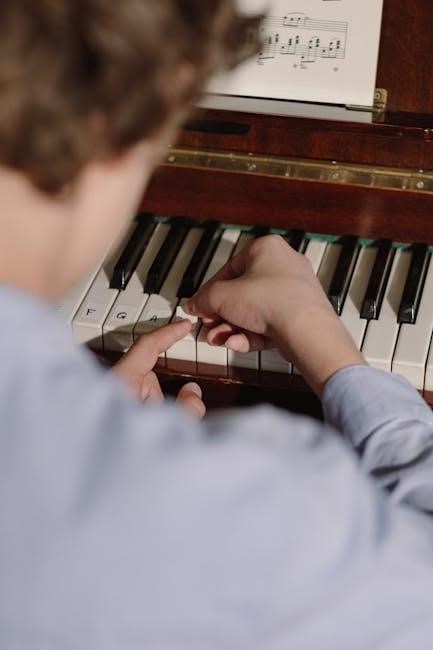
Dominant 7th chords are essential for adding harmonic tension and a sense of anticipation in music. A well-structured piano chord cheat sheet PDF will dedicate significant space to these, as they are foundational for many chord progressions. These chords consist of a root, major third, perfect fifth, and a minor seventh.
For example, G7 comprises G, B, D, and F. The added seventh creates a dissonant interval that strongly resolves to the tonic chord, typically a major chord. A good PDF resource will display dominant 7th chords in all keys, alongside suggested resolutions. Understanding these resolutions is key to effective songwriting and improvisation.
Many cheat sheets also include alterations to dominant 7th chords, such as G7b9 or G7#5, further increasing harmonic complexity. Mastering these chords, with the aid of a piano chord cheat sheet PDF, unlocks a wider palette of expressive possibilities and a deeper understanding of jazz harmony;
Chord Inversions: Expanding Your Sound
Chord inversions are a crucial concept for pianists seeking to move beyond basic chord voicings and create smoother, more interesting harmonic textures. A comprehensive piano chord cheat sheet PDF will illustrate these inversions clearly, showing how to rearrange the notes of a chord while maintaining its fundamental quality.

Instead of always playing a C major chord as C-E-G, inversions allow you to play E-G-C (first inversion) or G-C-E (second inversion). This alters the bass note and the overall sonic character of the chord. A quality PDF resource will demonstrate inversions for major, minor, and dominant 7th chords across various keys.
Understanding inversions facilitates smoother voice leading between chords, minimizing large jumps in the bass line. This is particularly important for creating professional-sounding accompaniments and arrangements. Utilizing a piano chord cheat sheet PDF to visualize and practice inversions significantly expands a pianist’s harmonic vocabulary and expressive capabilities;
Common Chord Progressions
Piano chord cheat sheet PDFs aren’t just about individual chords; they often include commonly used chord progressions – the building blocks of countless songs. These progressions provide a framework for improvisation, composition, and learning popular tunes. A good resource will showcase progressions in multiple keys, making them readily applicable to various musical contexts.
Classic progressions like I-IV-V-I (e.g., C-F-G-C in the key of C) and ii-V-I (e.g., Dm-G-C) are fundamental and frequently appear in diverse genres. A comprehensive PDF will not only list these progressions but may also indicate their harmonic function – tonic, subdominant, dominant – aiding in understanding why they work so well.
Beyond the basics, a useful piano chord cheat sheet PDF might present variations and extensions of these progressions, introducing passing chords or altered harmonies. Mastering these common sequences unlocks a pianist’s ability to quickly learn and play a vast repertoire of music.
Reading Chord Charts
A crucial skill for any pianist is understanding how to read chord charts, and a good piano chord cheat sheet PDF can significantly aid this process. Chord charts utilize symbols representing chords – like Cmaj, Dm7, or G7 – placed above lyrics or musical notation. These charts indicate which chords to play during specific sections of a song.
PDF resources often include a key explaining common chord symbols and their corresponding fingerings. Recognizing these symbols quickly is essential for efficient practice and performance. Charts may also show rhythmic notation, indicating when to change chords, or simply rely on the song’s structure for timing.
Understanding slash chords (e.g., C/G) – indicating a specific bass note – and inversions is also vital. A well-designed piano chord cheat sheet PDF will demystify these concepts, providing clear examples and diagrams. Ultimately, mastering chord chart reading empowers pianists to learn new songs independently and confidently.
Essential Chords for Beginners
A piano chord cheat sheet PDF geared towards beginners typically focuses on a core set of chords that form the foundation of countless songs. Mastering these chords unlocks a vast repertoire and builds essential finger dexterity. The most fundamental chords include C Major, G Major, D Major, A Major, E Major, and their relative minor counterparts: A minor, E minor, D minor, B minor, and F# minor.
These chords are frequently used in common progressions, making them ideal starting points. A good PDF resource will illustrate finger placements clearly, often with diagrams showing both hands. Learning to transition smoothly between these chords is key.
Beyond these, F Major and Bb Major are also frequently encountered. A comprehensive piano chord cheat sheet PDF will often include variations like seventh chords (e.g., Cmaj7, G7) to add color and complexity as skills develop. Consistent practice with these essential chords is the cornerstone of piano proficiency.

Piano Chord Voicings
Piano chord voicings refer to the specific arrangement of notes within a chord, impacting its overall sound and texture. A detailed piano chord cheat sheet PDF will often extend beyond basic triads, showcasing different voicings for each chord. These variations involve altering the order of notes or adding extensions like 7ths, 9ths, or 11ths.
For example, a C Major chord can be voiced in root position (C-E-G), first inversion (E-G-C), or second inversion (G-C-E). Different voicings create distinct harmonic colors. Spread voicings, where notes are spaced further apart, offer a wider sound, while close voicings are more compact.
Advanced PDF resources demonstrate how to create lush and interesting harmonies by strategically choosing voicings. Understanding voicings allows pianists to move beyond simple chord progressions and add a personal touch to their playing. Experimenting with different voicings is crucial for developing a sophisticated musical ear.
Using a Piano Chord Cheat Sheet PDF
A piano chord cheat sheet PDF is most effective when used as a learning aid, not a crutch. Begin by familiarizing yourself with the basic chord diagrams – root position triads are a great starting point. Practice transitioning between chords slowly, focusing on accuracy before speed.
Many PDFs categorize chords by key, making it easier to find chords relevant to a specific song. Utilize the cheat sheet to analyze songs you enjoy, identifying the chords used and their progressions. This builds your harmonic understanding.
Don’t limit yourself to just the diagrams; actively try to memorize the chord shapes. Supplement the PDF with online resources like Simply Piano or MIDI keyboard practice to reinforce learning. Regularly reviewing the cheat sheet and applying the chords in your playing will solidify your knowledge and improve your musicality.
Finding Reliable PDF Resources
Locating trustworthy piano chord cheat sheet PDF resources requires discernment. Many websites offer free downloads, but quality varies significantly. Look for resources from established music education sites or reputable piano instructors. Websites associated with piano brands, like those discussed in Piano Buyer, often provide accurate charts.
Beware of sites with excessive advertising or unclear origins, as these may contain errors. Check user reviews or forums for feedback on the resource’s accuracy. Consider PDFs created by experienced musicians or music theorists.
Exploring online music communities and educational platforms can also yield valuable recommendations. Remember to cross-reference information from multiple sources to ensure accuracy. A well-maintained, clearly organized PDF from a reliable source will be an invaluable asset in your piano learning journey.

Simply Piano App Integration
The Simply Piano app, praised for its beginner-friendly approach, can complement the use of a piano chord cheat sheet PDF. While the app provides interactive lessons and real-time feedback, a PDF offers a broader visual overview of chords. Users can reference a cheat sheet alongside the app’s lessons to reinforce learning and explore variations.
Simply Piano’s structured curriculum builds foundational skills, and a PDF allows for independent exploration of chords not immediately covered in the app. This combination caters to different learning styles – interactive for practice, visual for reference.
Some users have noted the app’s effectiveness in teaching basic music theory and hand coordination. A PDF cheat sheet then becomes a valuable tool for expanding beyond the app’s core lessons, fostering a more comprehensive understanding of piano chords and their applications.
MIDI Keyboard and Chord Learning
Utilizing a MIDI keyboard alongside a piano chord cheat sheet PDF offers a dynamic learning experience. MIDI keyboards, connected to computers or tablets, allow users to visually and aurally explore chords presented in the PDF. This pairing is particularly beneficial for those without immediate access to an acoustic piano.
The PDF serves as a visual guide, while the MIDI keyboard provides tactile feedback and the ability to hear the chords played. Software associated with MIDI keyboards often allows for chord inversions and voicings to be easily experimented with, enhancing understanding beyond basic chord diagrams.
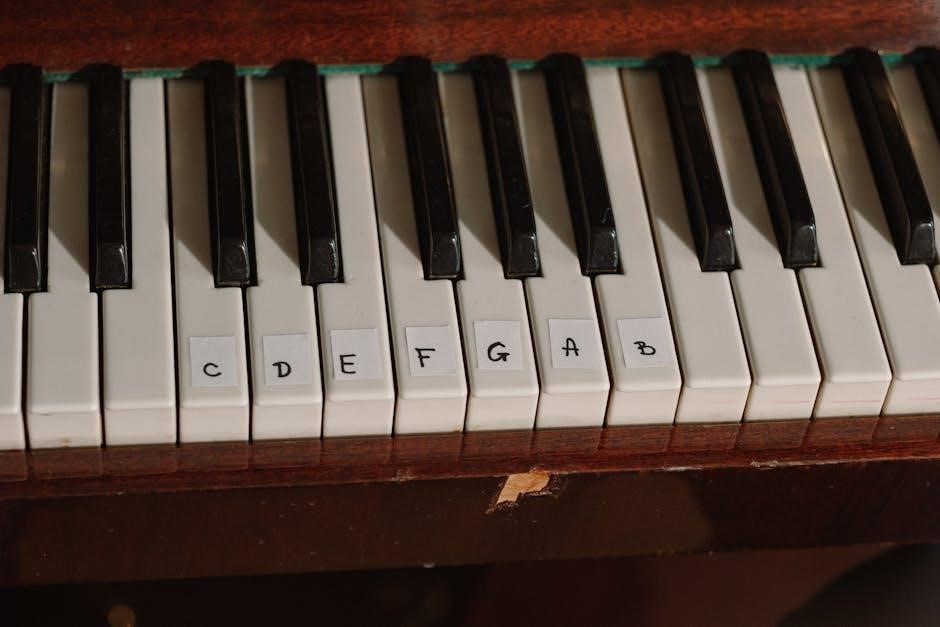
Beginners can use the PDF to identify chords and then practice playing them on the MIDI keyboard, reinforcing muscle memory. More advanced learners can explore complex chord progressions and experiment with different sounds and arrangements, all guided by the visual aid of the piano chord cheat sheet PDF.
Lang Lang’s Piano Collections
While Lang Lang’s piano collections don’t directly offer piano chord cheat sheet PDFs, studying his repertoire can indirectly enhance chord learning. Analyzing the chord progressions within his performances and transcriptions provides practical application of theoretical knowledge found in such PDFs.
His collections often feature arrangements of classical and popular pieces, showcasing a wide range of harmonic structures. By dissecting these arrangements, students can identify common chord voicings and progressions, effectively expanding their understanding beyond basic chord charts.

Supplementing study of Lang Lang’s work with a dedicated piano chord cheat sheet PDF allows for a combined approach. The PDF provides the foundational knowledge, while his music offers real-world examples of how those chords are used in context. This synergy fosters a deeper appreciation for musical harmony and improves improvisational skills.
The History of the Piano & “Piano” Etymology
Understanding the piano’s history illuminates why piano chord cheat sheet PDFs are so useful today. The instrument’s evolution, from the harpsichord to the modern piano-forte, involved increasingly complex harmonic possibilities. Early pianists needed methods to quickly grasp these changes, foreshadowing the need for concise chord references.
The word “piano” itself, short for “pianoforte” (Italian for “soft-loud”), highlights the instrument’s dynamic range – a range that necessitates understanding varied chord voicings. A piano chord cheat sheet PDF helps navigate this complexity, offering visual representations of chords and their inversions.
As the piano gained popularity, standardized chord notation became essential; Modern PDF cheat sheets are a direct descendant of these early attempts to systematize harmonic knowledge. They represent centuries of musical development condensed into a readily accessible format, aiding both beginners and experienced players.
Advanced Chord Types (Diminished, Augmented)
Piano chord cheat sheet PDFs aren’t limited to major and minor chords; they often extend to more complex harmonies like diminished and augmented chords. Mastering these requires a dedicated resource, and a well-structured PDF provides that.
Diminished chords create tension and are frequently used as passing chords, while augmented chords offer a unique, often unsettling, quality. Visualizing these on a piano chord cheat sheet is crucial, as the fingerings differ significantly from basic chords.
Advanced PDFs will detail the construction of these chords – the specific intervals that define them – and demonstrate their inversions. They may also illustrate how these chords function within common progressions. Understanding diminished and augmented chords unlocks a wider palette of expressive possibilities, and a comprehensive PDF is an invaluable tool for exploration.
Resources for Piano Learning (Ebooks, Webinars)
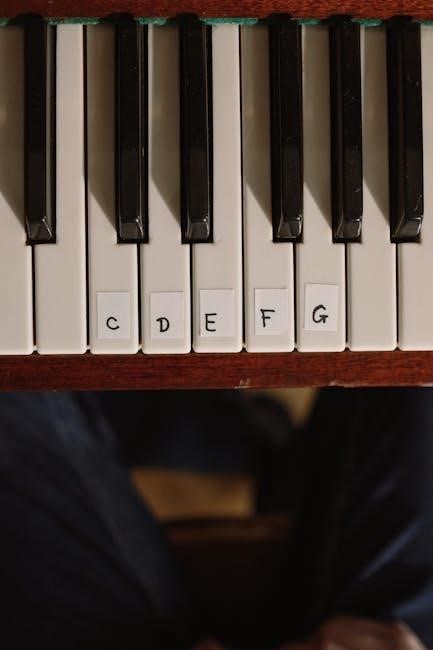
While a piano chord cheat sheet PDF is a fantastic starting point, sustained learning requires broader resources. Many websites offer complementary ebooks and webinars designed to deepen your understanding of music theory and piano technique.
These resources often build upon the foundational knowledge presented in a PDF cheat sheet, expanding into topics like scales, arpeggios, and more complex chord progressions. Webinars provide interactive learning experiences, allowing you to ask questions and receive personalized feedback.
Look for ebooks that specifically address chord voicings and inversions, complementing the visual guide of a piano chord cheat sheet PDF. Some platforms even integrate PDFs directly into their learning modules. Combining a visual reference with structured lessons accelerates progress and fosters a more comprehensive musical education.
Troubleshooting Common Chord Issues
Even with a piano chord cheat sheet PDF, beginners often encounter difficulties. A common issue is cleanly transitioning between chords; practice slow, deliberate changes focusing on finger placement. Muted or buzzing sounds can indicate improper finger pressure or technique – ensure firm, rounded fingertips.
Another frequent problem is memorizing chord shapes. Don’t just rely on the PDF; actively use the chords in simple songs. Difficulty with inversions? Refer back to diagrams and practice each inversion separately.
If chords sound “wrong,” double-check the notes against your piano chord cheat sheet PDF and ensure correct fingering. Remember, consistency and slow, focused practice are key. Utilize online forums or a teacher for personalized guidance when facing persistent challenges.